Dive Brief:
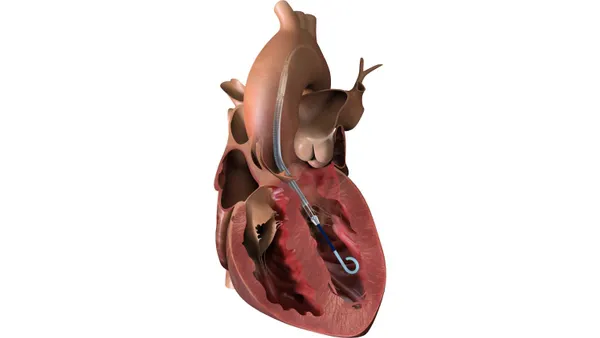
- Medtronic has received a CE mark for its OmniaSecure small-diameter defibrillation lead, the company said Monday.
- OmniaSecure builds on the company’s SelectSecure Model 3830 pacing lead. With patients living longer, Medtronic aimed to create a defibrillation lead that has the safety benefits of a small diameter without compromising durability.
- Medtronic, which recently won an expanded OmniaSecure label in the U.S., has worked with European hospitals on the first commercial implants of the lead in the right ventricle.
Dive Insight:
Standard, larger-diameter leads are associated with downstream complications such as venous occlusion or tricuspid valve regurgitation, fueling interest in narrower devices. However, initial attempts to make the devices narrower created new safety concerns.
Medtronic voluntarily stopped selling its Sprint Fidelis lead in 2007 because of an abnormally high rate of lead failure. St. Jude Medical, now part of Abbott, recalled certain Riata leads in 2011. The Sprint Fidelis and Riata leads had smaller diameters than standard leads such as Medtronic’s Sprint Quattro.
A paper co-authored by Medtronic employees called defibrillation leads “the Achilles heel of implantable cardioverter-defibrillators.” Patients who need the devices to treat dangerously abnormal heart rhythms are living longer. At the same time, improvements to battery life mean the devices need replacing less often. The shifts have created a need for narrow-diameter leads that reliably work for decades.
Medtronic sought to meet that need by modifying a pacing lead. Rather than trying to downsize an existing defibrillation lead, the company chose the SelectSecure Model 3830 as its starting point. The pacing lead came to market in 2003 and has achieved a 97.5% survival rate at 13 years. Like the SelectSecure lead, OmniaSecure is designed to avoid fractures and enable a smaller lead diameter.
The company has evidence OmniaSecure achieved its goals. Researchers modeled 10-year fracture-free device survival rates of 98.2% for OmniaSecure, 96.6% for Sprint Quattro 6947 and 87.1% for Sprint Fidelis 6949. Sprint Fidelis’ shortcomings were particularly pronounced in people aged 12 to 22, where the device had a survival rate of 77.4%. OmniaSecure’s survival rate in younger patients was 97.9%.
The CE mark clears OmniaSecure for use in right ventricular stimulation. Medtronic’s recently expanded U.S. label supports left bundle branch placement.